
how our tyvek wallets actually get made
we make every one by hand in prague, so we sat down with michal, our founder and the person who drew all six designs, and asked him the obvious things. he starts with the laser that lost to a hobby plotter, and it only gets more honest from there.

you can find a fold-it-yourself tyvek wallet guide in about four seconds. instructables has one, so does half of youtube. fold, tape, done.
the question we actually get is the harder one: how do you make one you'd sell to a stranger and not wince? so we put that one, and every other obvious question, to michal. the questions here are ours. every answer below is his, mistakes and all.
every wallet here is still folded by hand, about 10 minutes each, and mostly only after someone orders it. there's no warehouse and no overproduction.
let's start with the dumb question. what is it?
the dumb questions are usually the good ones :) almost nobody around me had a clue what tyvek was until they started carrying one of these. so i've got a go-to line for it: you know those wristbands they put on you at a festival, the ones you can never rip off? near enough the same material. it's high-density polyethylene spun into a thin sheet, which is why water just beads off it and why an empty wallet is about 9 grams. we've got it in our hands most days, and it still quietly wins me over.
and why that, out of everything you could make a wallet from?
because i wanted something better than the wallet i already had, and leather wasn't it. i use one specific grade, dupont™ tyvek® 1073d, the medium-weight stock made to be printed on. and here's the part i like: dupont makes tyvek in only two factories on the whole planet, one in virginia and one in contern, luxembourg, and ours comes from the european one. it never travels further than it has to, and it never comes from wherever's cheapest. i sleep better for it.
so where's the catch?
ink, mostly. tyvek doesn't drink ink the way paper does, so nothing soaks in, it all just sits on top and has to be talked into staying. which is exactly where my early trouble started.

why is there almost never a black one?
people ask for black constantly, and i get it, black goes with everything. but black is the one colour tyvek won't hold onto. i print offset, and the surface flexes every single time the wallet opens, so on a solid black the ink is the first thing to crack and rub thin. i've stayed away from it on purpose, and it turns out i'm not the only one who ran into that.
so my prints run bright, and not only because i like them that way. the colour is the entire point of the wallet, and it's also the first thing to fail if you get greedy. getting a print to survive a real pocket took five different printers. i even had one batch made abroad, further from prague than i was comfortable with, and it came back a notch below what i could already do at home. that was the last time i went looking further than i had to.

six designs made it onto a wallet. how many didn't?
about forty-four. before there were six there were something like fifty designs, some drawn by hand, some built on screen, most of them quietly walked to the bin. the six that made it aren't the flashiest ones, they're the ones that still looked right after i'd stared at them for months and carried them around town. a design has to earn its spot the same way the folds do. i have real affection for a couple of the rejects. they were just wrong.

okay, we have to talk about the laser.
this is the one i went furthest down the rabbit hole on. everyone online says just use a craft knife, and for the first fifty that's fine, but the edges are never the same twice, and i couldn't hand someone a wallet with an edge i wasn't happy with. so i bought a laser cutter.
and did it work?
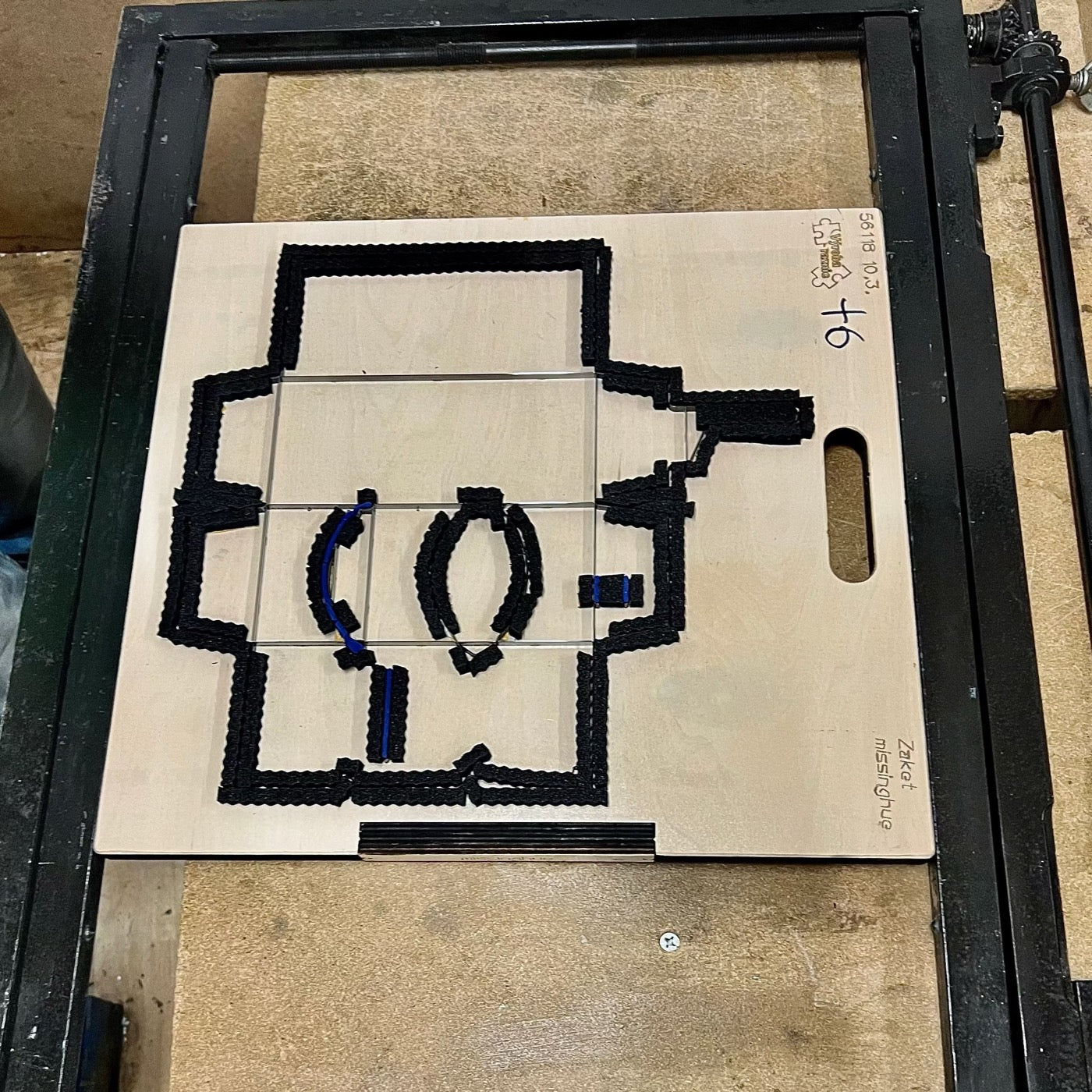
not at all, and not for the reason you'd expect. it wasn't the money, a small one is maybe ten thousand crowns. it's that tyvek is white and a little glossy, which is exactly what a laser struggles with, the beam scatters off the surface instead of cutting clean. so i sold it, and the boring thing that actually worked was a hobby plotter that cost about the same. i still cut every prototype on it today, and the clean identical stamp, the die-cut, gets done later at the printer.
and the size, is it as fiddly as it looks?
worse. the whole fight is in tenths of a millimetre: too loose and your cards slide out in your pocket, too tight and you can't get them in at all. every version gets drawn in fusion 360, cad software i taught myself, so the cut comes out the same shape every time.
no thread, no wet glue. so what holds it together?
it used to be liquid glue. it worked, but i didn't love breathing it over a workbench all day, and it never set the same way twice. so now it's a double-sided tape, 3m 300lse. it's still an adhesive, of course, it just doesn't stink and it behaves the same every single time.
the "lse" stands for low surface energy, which is a fancy way of saying it was engineered to grip the exact plastic most glue slides straight off. tyvek being, of course, exactly that plastic. i felt extremely clever for about a day, until i realised i'd just googled hard enough. each wallet folds down in three and holds on six taped joins, five of them doing the actual work and one that's really there for the look of it. inside sit two pieces of pet, each about the size of a credit card, that keep the whole thing in shape, and yes, they're recyclable too.
one wallet is ten minutes. so why isn't the whole thing fast?
because the ten minutes is the easy part. nothing is made for a warehouse, most wallets are folded only once someone orders. and i do mean right now, the plan is to grow a proper team and take this further than one pair of hands can. the first big company order taught me that the fast way, i folded the whole batch myself and my hands nearly filed for divorce. trippy and blue, the two prints people reach for most, i keep a few on the shelf, otherwise i don't overproduce, because overproduction is just landfill with extra steps.
and the last check before one ships?
there's no lab for this part, so we just wear them. a print or a fold only shows its real character after a few weeks in a pocket, sometimes months. which corner rubs, which edge lifts, whether the card still sits where it should. survive that and it earns the press. if it doesn't, back in the folder it goes, with the other 44.

i don't even know it's there. almost two years, every day in my pocket, not a single problem.
simon · almost 2 years of daily carry · review on our instagramafter all of that, what keeps you doing it?
honestly? i still carry one every single day, and i've never found anything i'd rather switch to. it started as me fixing my own pocket, but that stopped being the point almost immediately. what i care about now is the moment someone tips a fat leather wallet they've been sitting on for years into nine grams of this, feels their back pocket go flat, and just quietly goes "huh". that "huh" is the whole job.
the first ones went to friends and family, and the part that got me wasn't the compliments, it was that they never gave them back. they just kept carrying them, every day, and coming back asking for the next print. these are people who'd absolutely tell me if it was rubbish. when they kept using them instead, it stopped being a thing i was in love with alone and started feeling like something real.
most people who try one don't go back, and i don't think that's magic. it's just that once the thing you carry every day weighs nothing and still holds everything you actually reach for, the old brick starts to feel a little absurd. i'd love more people to feel that.
i keep carrying every mistake in my own pocket until it stops being one. the wallet that reaches you already has.


how are tyvek wallets made?
is a tyvek wallet made of paper?
why don't your wallets come in black?
are the wallets made to order?

made by hand, one at a time
6 designs, each drawn by the founder and carried until it held up. pick the one that's yours.
choose your print€26 · made in prague · 24-month warranty
material and manufacturing facts are our own, from the prague studio. the tyvek grade and the two-plant sourcing are dupont's published product data; the black-print quote is from slimfold's own blog, linked above and checked 23 july 2026; customer quotes come verbatim from our instagram. spot something off? tell us through the contact form. tyvek® and dupont™ are trademarks of dupont de nemours, inc.; 3m™ and 300lse are trademarks of 3m; fusion 360 is a trademark of autodesk; silhouette is a trademark of silhouette america. slimfold is a trademark of its owner. missinghue is not affiliated with any of these companies.